Mobile RPG · Independent guide
RAID: Shadow Legends explained: how the game actually works
Advertising disclosure
This article contains a partner link to RAID: Shadow Legends. If you install the game after following it, the advertiser may pay Chobichous s.r.o. a commission. It costs you nothing extra, the price of anything in the game is unaffected, and no advertiser saw this article before it was published. We are an independent publisher with no connection to Plarium. Where this article is critical of the game, that criticism stayed in. See the advertising disclosure and the editorial policy.
RAID: Shadow Legends has been advertised at more or less everyone with an internet connection. What almost none of that advertising explains is how the game is actually constructed: what you do with your time, what limits you, and where the money goes. This guide does that, including the parts a marketing page would leave out.
About the illustrations: every diagram below is an original vector drawing made for this article. They are not screenshots and contain no artwork belonging to the game’s publisher.
What it is, in one paragraph
RAID: Shadow Legends is a free-to-download, turn-based collection role-playing game for iOS and Android, also playable on Windows through the publisher’s own desktop client. It was released in 2018 by Plarium, a studio that has been part of the Australian gaming group Aristocrat Leisure since 2017. You collect champions, equip them, level them, and send teams of them into a series of repeatable battles. Combat is automated turn by turn once you choose which skill to use; the real decisions are made before the fight, in who you bring and what they are wearing. The game is monetised through optional purchases, and the most important of those are randomised.
It is a large, long game. People who stick with it measure their accounts in years, not weeks. That is either the appeal or the warning, depending on the kind of player you are.
The combat engine: speed decides everything
If you only understand one mechanic before you start, make it this one. Turn order in RAID is not a fixed rotation. Every champion, yours and the enemy’s, has a turn meter that fills continuously in proportion to its Speed (SPD) stat. When a meter reaches 100%, that champion takes its turn and the meter empties.
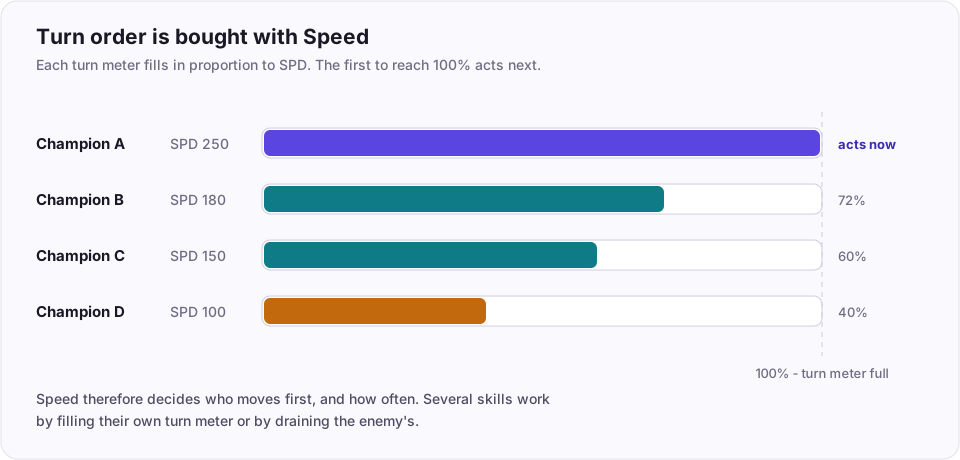
The consequence is simple and it shapes the entire game: a champion with twice the Speed of another gets roughly twice as many turns. Speed is not a tie-breaker, it is a damage multiplier, a healing multiplier and a survival multiplier all at once, because every one of those things happens on a turn.
On top of that, a large number of skills manipulate the meter directly — filling your own team’s, draining the enemy’s, or granting an extra turn. Serious endgame team-building in RAID is largely an exercise in tuning Speed values so that your champions take their turns in a specific repeating order. That is also why a champion that looks unremarkable on paper can be central to a team: it is not the damage number, it is where the turn lands.
The stats that matter, and why
| Stat | What it does | Who needs it |
|---|---|---|
| HP | Health pool | Everyone; the scaling stat for some champions’ damage |
| ATK | Attack power | Damage dealers |
| DEF | Damage reduction | Tanks; also a damage stat for some champions |
| SPD | Fills the turn meter | Everyone, always |
| C. RATE / C. DMG | Chance of a critical hit, and its size | Damage dealers |
| ACC | Whether your debuffs land | Debuffers — without it they do nothing |
| RESIST | Whether enemy debuffs are blocked | Arena defence, some bosses |
Accuracy deserves a sentence of its own, because missing it is the single most common early mistake. A debuffer whose Accuracy is below the content’s requirement does not land a weaker debuff; it lands nothing. The champion contributes an empty turn. If a team is inexplicably failing a dungeon, this is usually why.
Affinities: the rock-paper-scissors layer
Every champion has one of four affinities. Three of them form a cycle, and the fourth sits outside it.
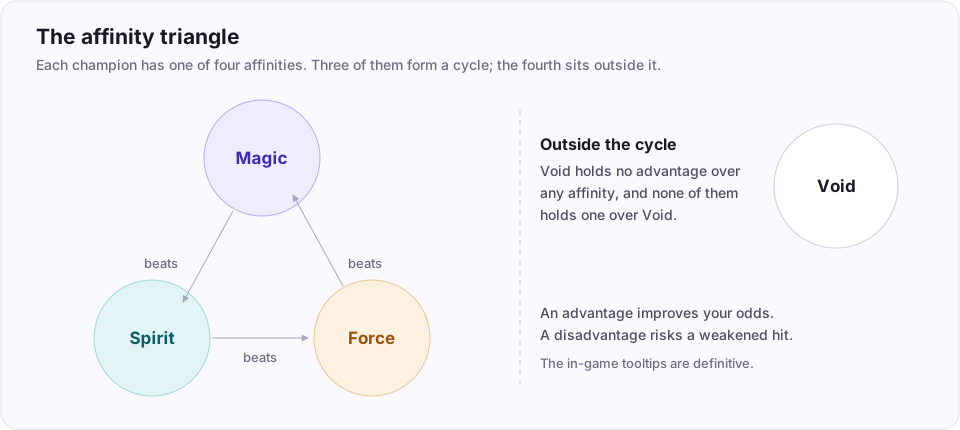
Magic has the advantage over Spirit, Spirit over Force, and Force over Magic. Void has no advantage over anything, and nothing has an advantage over Void. Attacking into an advantage improves your chances; attacking into a disadvantage risks a weakened hit that does less than it should. The exact effect is described in the game’s own tooltips, which are the version you should trust.
This matters more than it first appears, because several pieces of content are affinity-locked: a dungeon rotation may present you with enemies of a single affinity, and a roster that is heavily weighted towards one element will stall there. A balanced collection is not an aesthetic preference, it is a requirement.
Champions: rarity, role, faction
Each champion carries four labels that together determine where it is useful.
- Rarity — Common, Uncommon, Rare, Epic and Legendary, with a higher tier added in a later update. Higher rarity generally means better base stats and better skills, though a well-equipped Rare champion outperforms a neglected Legendary for a long time.
- Role — Attack, Defence, HP or Support, which signals how the champion’s damage scales and what it is built for.
- Faction — the in-world group it belongs to. There are more than a dozen, and at least one mode requires you to field teams drawn from a single faction, which quietly turns “collect everything” into an objective rather than a hobby.
- Affinity — as above.
There are several hundred champions and new ones are added regularly; the in-game champion list is the only count worth quoting. Each one also has a mastery tree, a long-term talent system unlocked over time, and skills that can be upgraded with consumables to shorten cooldowns.
Building a team that actually functions
New players tend to field their five highest-rarity champions. That is almost never the best team. RAID rewards roles, and a functioning team usually covers most of these:
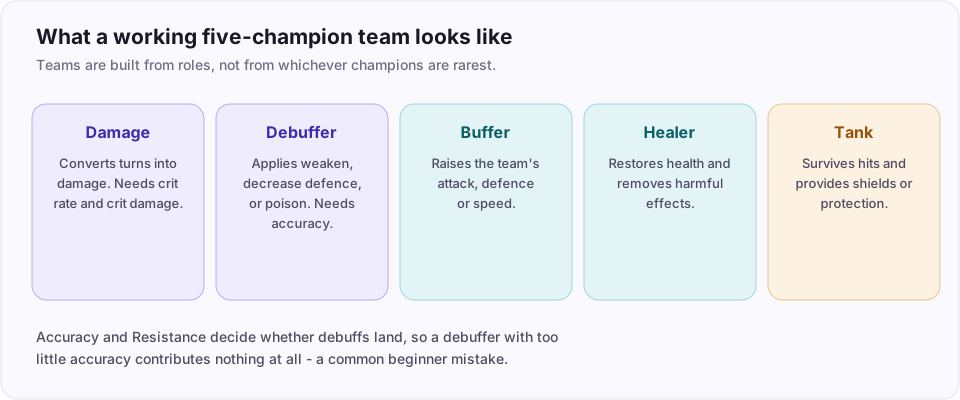
The pattern that beats most early and mid-game content is unglamorous: one champion that reduces enemy defence, one that increases your team’s attack or speed, one that heals or cleanses, and one or two that actually deal the damage. Remove the debuffer and the damage dealers look feeble. Remove the healer and everything works until it suddenly does not.
Gear is the real game
Champions provide skills. Gear provides the numbers. Six armour slots and three accessory slots carry almost all of a developed champion’s stats, and gear comes in sets whose bonus only applies when you equip enough matching pieces.
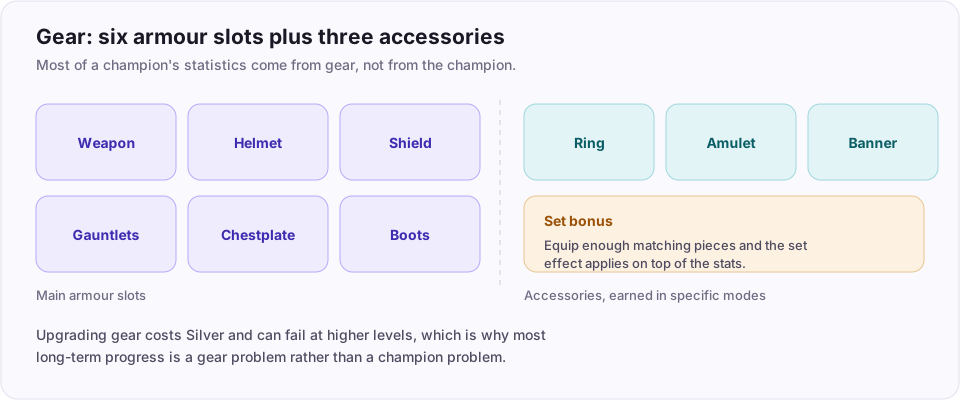
Sets cover the obvious territory — Speed, Life, Offense, Defense, Lifesteal, Critical Rate, Critical Damage, Accuracy, Resistance and a long list of more specialised ones. Each piece also has a main stat and up to four substats, and those substats improve as you upgrade the piece with Silver.
Two things about gear surprise people:
- Upgrading can fail. Above the early levels, an upgrade attempt consumes Silver and may simply not work. Gearing a champion properly is expensive, and the expense is in Silver, not money.
- Gear is where the endgame lives. After the first few months, almost nobody is stuck because they lack a champion. They are stuck because they lack the gear to make the champions they already own perform. This is also why dungeon farming never really ends.
Where you will spend your time
The modes are not really separate games; each one produces a resource that another one consumes.
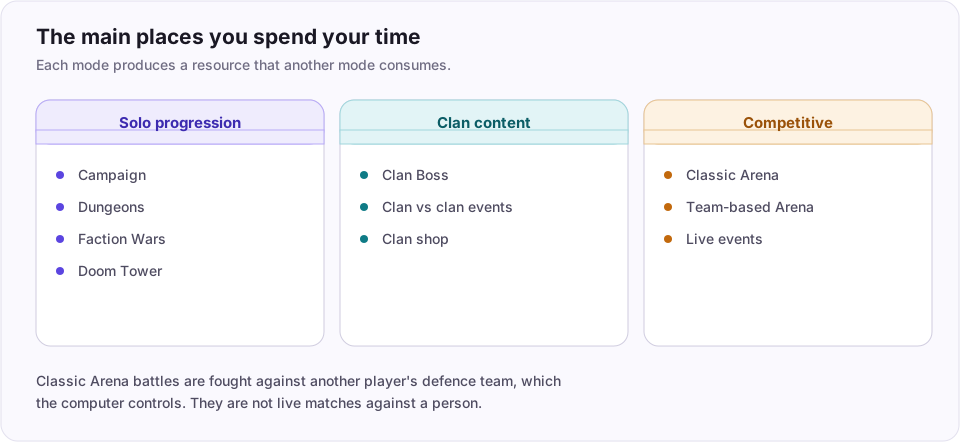
- Campaign — the story mode, a series of chapters replayable at escalating difficulty. The standard early source of experience, Silver and low-rarity champions used as upgrade material.
- Dungeons — repeatable bosses, each with its own mechanic: the Dragon’s Lair, the Ice Golem’s Peak, the Fire Knight’s Castle, the Spider’s Den, the Minotaur’s Labyrinth and the elemental Potion Keeps. This is where gear and upgrade materials come from.
- Clan Boss — the shared fight. Every member of your clan attacks the same boss from their own account, and rewards scale with the difficulty tier your clan can beat. Later co-operative bosses such as the Hydra work on a similar principle with more moving parts.
- Arena — the competitive mode. Important correction to a common misconception: classic Arena is not live player-versus-player. You attack a defence team that another player has set up, and the computer controls it. They are not online, and they are not choosing the skills.
- Faction Wars — despite the name, a solo mode. Each stage restricts you to champions of one faction, which is the mechanism that makes a broad roster valuable.
- Doom Tower — a rotating multi-floor challenge with its own bosses and hidden rooms, refreshed periodically.
Energy and the daily loop
You cannot play RAID for as long as you like. Battles consume Energy, Energy refills over real time, and the cap grows slowly as your account level rises. In practice the game is a series of short sessions: spend the Energy that accumulated while you were away, collect the rewards, spend them on upgrades, come back later.
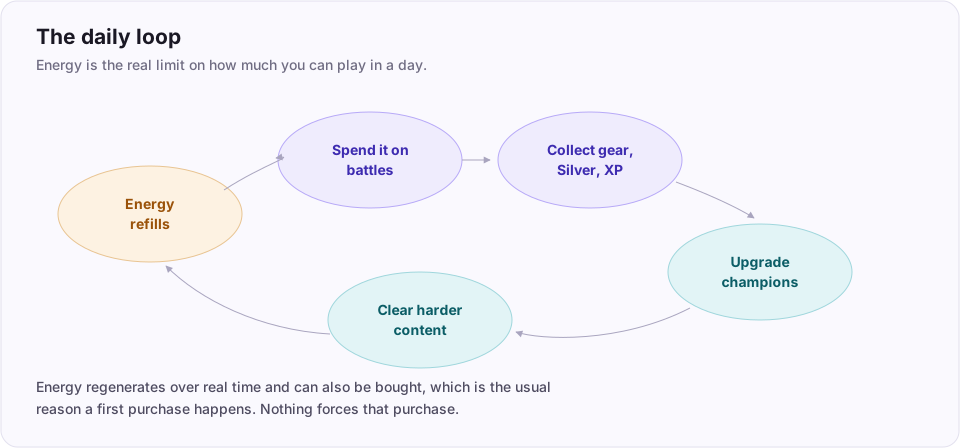
Whether that is a feature or a flaw depends entirely on you. For someone with twenty spare minutes a day it is a sensible structure. For someone who wants to sit down for three hours on a Sunday, it is a wall — and the game will cheerfully sell you a way through it. That is not an accident; it is the design.
How the game makes money
This is the section that marketing pages do not write, so here it is plainly.
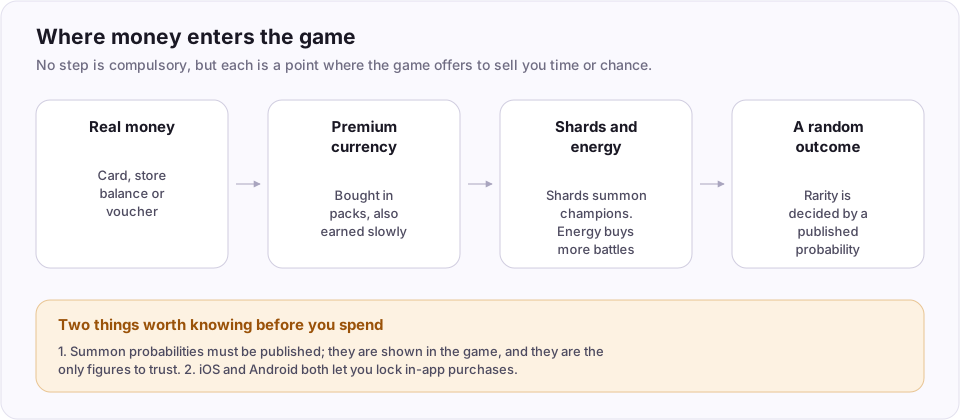
RAID is free to download and sells optional purchases. Those purchases fall into three groups:
- Time. Energy refills, which remove the pacing limit described above.
- Convenience and progression. Resource packs, Silver, upgrade materials.
- Chance. Shards, which summon a champion of a randomly determined rarity. This is the important one.
What you are actually buying with a shard
You are not buying a champion. You are buying a probability. This is the mechanic generally called gacha, and it is the main revenue engine of the game.
The publisher is required by both major app stores to disclose the odds of randomised purchases, and RAID does: there is a drop-rates screen in the game. Those published figures are the only ones worth trusting, including over anything written on this page. What is safe to say in general terms is that the chance of pulling a Legendary from the cheapest premium shard is a fraction of one percent, and that a “mercy” mechanic raises your odds after a long run of unsuccessful summons, with the thresholds published in-game. Anyone telling you a guaranteed number of pulls to a guaranteed outcome is either quoting the mercy threshold imprecisely or making it up.
If you are going to spend, do it deliberately
- Decide a monthly figure before you open the shop, not after a bad run of summons.
- Both iOS and Android let you disable or password-protect in-app purchases. If anyone else uses your device, do that now rather than later.
- A randomised purchase is a purchase of a chance. Judge it as entertainment spending, not as an investment in an account.
- If chasing an outcome stops feeling optional, that is a reason to stop playing, not a reason to spend more.
The regulatory picture in the EU
Paid randomised rewards are an active regulatory question in Europe rather than a settled one. Belgium’s Gaming Commission concluded in 2018 that certain paid loot-box mechanics fall under its gambling legislation; other member states have examined the question under consumer law instead. In January 2023 the European Parliament adopted a resolution on consumer protection in online video games, calling for a more harmonised approach to loot boxes, in-game currencies and the protection of minors. More recently the European Commission and the national consumer-protection authorities have turned their attention specifically to in-game virtual currencies and how their real cost is presented. None of this is a finding against any particular game; it is the backdrop, and it continues to move.
Is it free-to-play friendly? An honest answer
You will see the claim that RAID is unusually fair to free players, and that the strongest champions can be obtained through normal play rather than the shop. That claim is at best half true, and we are not going to repeat it here just because this page carries advertising.
What is true:
- A very large amount of content is reachable without paying. Campaign, most dungeons at most levels, clan boss at the lower tiers, and a competitive-enough Arena bracket are all accessible to a patient free account.
- Shards are earned through play. You will summon champions without paying.
- Gear, not champions, is the long-term bottleneck, and gear is farmed rather than bought outright.
What is also true:
- The high-rarity champions come from a randomised system with published odds that are low. Playing more does not improve the odds of any individual summon; it only gives you more of them.
- Progress for a free account is measured in months and years, not weeks.
- Energy is a real limit, and removing it costs money.
The fair summary: RAID is playable for free and it is not pay-to-win in the sense that money buys an unbeatable position — but money buys time and attempts, and over a long enough period that is a substantial advantage. If you are comfortable with slow progress and you enjoy the optimisation puzzle, the free experience is genuinely large. If you need to keep pace with the top of the Arena, it will not be free.
Want to try it yourself?
RAID: Shadow Legends is free to download on iOS and Android, and playable on Windows through the publisher’s desktop client. Read the sections above on monetisation first, set your purchase controls, and then decide.
Get RAID: Shadow Legends — free to downloadPartner linkPartner link. We earn a commission if you install the game through it. This costs you nothing extra and does not affect our assessment.A realistic first month
A sensible order of operations, with no promises attached to it.
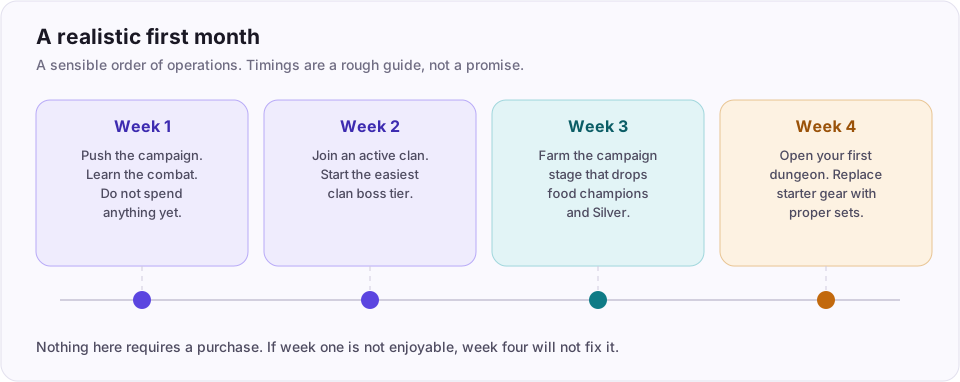
- Week one: push the campaign and learn the combat. Do not spend anything. You do not yet know what you would be buying.
- Week two: join an active clan. This is the single highest-value free action in the game. An active clan unlocks shared boss rewards and a shop you cannot otherwise access.
- Week three: settle into farming. Identify the campaign stage that efficiently produces upgrade fodder and Silver, and run it. Start putting Accuracy on your debuffer.
- Week four: open your first dungeon and fix your gear. Replace the random starter equipment with matched sets. This is the point at which most accounts either click or stall.
If you are not enjoying week one, week four will not rescue it. The game does not fundamentally change later; it gets bigger.
Who it suits, and who should skip it
A good fit if you
- enjoy optimisation puzzles and spreadsheet-adjacent thinking;
- are happy with short daily sessions over a long period;
- like co-operative, low-pressure social play in a clan;
- can treat a randomised shop as something you ignore.
Skip it if you
- want fast, manual, reflex-based combat;
- dislike daily-login structures and energy timers;
- want a finite game with an ending;
- know that randomised purchases are a problem for you. This is the most important item on either list, and there is no shame in it.
Before you install: four practical checks
- Storage and device. This is a large install that grows with updates, and it is demanding on older phones. The current download size and minimum OS version are on the App Store and Google Play listings. We do not quote a figure here because it changes with every patch.
- Age rating. The store listings carry a teen-level rating and the game contains randomised paid items. Check the current rating in your own store before installing it for someone else.
- Purchase controls. Set them before you play, not after. iOS Screen Time and Google Play’s purchase authentication both do this in under two minutes.
- Account linking. Link your progress to an account early so it survives a lost or replaced device.
Download RAID: Shadow Legends
Free to download, with optional in-app purchases. Everything we think you should know before installing it is in the sections above — particularly how the game makes money.
Download RAID: Shadow LegendsPartner linkPartner link. We earn a commission if you install the game through it. This costs you nothing extra and does not affect our assessment.Corrections to the earlier version of this page
An earlier version of this article contained claims that were wrong or misleading. In line with our editorial policy, they are listed here rather than quietly deleted.
| Earlier claim | What is actually the case |
|---|---|
| “Guilds” and a “Guild Wars” mode where guilds fight each other | The game’s social group is a clan, and the co-operative content is the Clan Boss. There is no mode called Guild Wars. Faction Wars exists but is a solo mode. |
| Progression is driven by “gold” | The soft currency is Silver. Gems are the premium currency. |
| Arena is “real-time PvP against other players” | Classic Arena is asynchronous. You fight another player’s defence team, controlled by the computer. |
| “The Dungeon”, a single mode | There are several distinct dungeons, each with its own boss and mechanic. |
| The game is “remarkably fair” and the most powerful champions are obtainable through regular gameplay rather than the shop | Misleading. High-rarity champions come from randomised summons with published low odds. Removed and replaced with the honest assessment above. |
| A “balanced, skill-based combat system” | Unsupported marketing language. Combat outcomes are driven mainly by stats, gear and turn order. |
| “Millions of active players” | We have no verifiable figure for active players. Store listings report cumulative downloads, which is a different thing. The claim was removed rather than re-sourced. |
| The page was framed as a “reader story” / “reader-submitted” account | It was not. That framing has been removed entirely; this is a signed editorial article. |
| Progression is “transparent, with no mystery or frustration” | Removed. Summon outcomes are random and gear upgrades can fail, which is the opposite of frustration-free. |
Sources
- Plarium, official game information and patch notes — plarium.com.
- The game’s own in-game screens: the drop-rates screen, champion tooltips and the mode descriptions. These are authoritative for mechanics and probabilities.
- The App Store and Google Play listings for download size, minimum operating system and age rating.
- Apple App Store Review Guidelines and Google Play developer policies, which require disclosure of the odds of randomised in-app items.
- European Parliament resolution of January 2023 on consumer protection in online video games — europarl.europa.eu.
- Belgian Gaming Commission, 2018 analysis of loot boxes under Belgian gambling law — gamingcommission.be.
In case of divergence, the publisher prevails. RAID: Shadow Legends is updated constantly: champions are rebalanced, modes are added, prices change. Where anything in this article differs from Plarium’s own current information or from what the game shows you on screen, the publisher’s information is correct and this article is out of date. Tell us and we will fix it: info@meritor.online.
Trademarks. RAID: Shadow Legends and Plarium are trademarks or registered trademarks of their respective owners. meritor.online is an independent publication and is not affiliated with, endorsed by or sponsored by Plarium Global Ltd. or any of its group companies.